
Understanding Hospital-Grade Disinfectants
Defining Hospital-Grade vs. General-Purpose Disinfectants
Every year, thousands of South African patients contract infections while receiving care. The choice of cleaning agents directly influences those numbers. In my years visiting rural clinics, I have seen the difference a proper disinfectant makes. Understanding which disinfectant is used in hospital wards requires looking beyond brand names at the regulatory markers printed on each bottle.
Hospital-grade disinfectants carry specific approvals that general-purpose products do not. They undergo testing against pathogens like Mycobacterium tuberculosis, Pseudomonas aeruginosa, and the hepatitis B virus. General-purpose cleaners simply remove visible dirt; they lack the chemical contact time needed to kill resistant organisms.
Key distinctions include:
– Valid registration with health authorities such as SAHPRA.
– Proven efficacy against a defined set of hospital pathogens.
– Label instructions that specify dilution and contact time.
These factors matter because a cleaner that works at home may fail entirely in a clinical environment. The question of which disinfectant is used in hospital settings is answered by registration, not reputation.
The Role of Disinfectants in Infection Control
Every year, hospital-acquired infections add thousands of extra days to patient stays across South Africa’s public and private healthcare facilities. The chemical agents used on high-touch surfaces determine whether those numbers climb or fall. In the corridors of a busy Johannesburg tertiary hospital or a small Western Cape district clinic, the answer to which disinfectant is used in hospital is often a careful calculation, not a simple off-the-shelf choice.
The disinfectant must perform specifically while staff are under pressure. It must be safe to use near patients and must work without damaging sensitive medical equipment. The true role of these products is to break the chain of transmission before pathogens ever reach a vulnerable patient.
For environmental hygiene teams, the most critical aspects often come down to practicality and efficacy. Consider the specific requirements that shape their daily choices:
– Contact time that suits the clinical workflow without sacrificing complete surface coverage.
– A registered label that matches the organism profile of the region.
– Dilution controls that are simple to implement for overworked nursing staff.
These elements matter deeply in facilities where budgets are tight and time is a luxury. The decision on which disinfectant is used in hospital settings sits at the intersection of science and daily routine. A product that works flawlessly in a laboratory setting may falter on a busy ward where surfaces are contaminated with organic matter. Environmental hygiene in SA public facilities relies on products that can handle those real-world conditions, not just ideal scenarios.
High-touch surfaces like bed rails and trolleys are a constant risk point in infection control. Every cleaning round with a compatible agent represents a deliberate act of patient safety. Even the most skilled clinicians depend on that single step, a cleaning protocol performed correctly with the right product. This makes the selection of the correct agent a core part of the infection control strategy, one that benefits every patient who enters the system. The question of which disinfectant is used in hospital is therefore not merely a technical choice; it is a decision that directly affects the quality of care delivered.
Key Terminology: Bactericidal, Virucidal, and Sporicidal Activity
The label on a hospital disinfectant can look like a secret code if you do not know what the terms mean. Bactericidal means the product kills vegetative bacteria, including problematic strains like Staphylococcus aureus. Virucidal means it inactivates enveloped and non-enveloped viruses, which matters in respiratory season. Sporicidal activity is the most demanding benchmark because spores are the hardest biological structures to destroy. When you ask which disinfectant is used in hospital practice, the answer depends on the resistance level of the pathogens you are targeting.
Consider the hierarchy of resistance when choosing a product for a high-risk ward:
– Bactericidal agents handle routine bacterial contamination.
– Virucidal agents cover viral threats like norovirus.
– Sporicidal agents are reserved for outbreaks involving Clostridium difficile or anthrax.
This terminology is not academic. A cleaner who grabs a bactericidal wipe during a viral outbreak is wasting time and risking patient safety. The claims on the label must match the threat on the ward. In South African facilities, where resources are often stretched, reading the fine print is a practical skill, not a bureaucratic exercise. Knowing the difference between these activities helps environmental hygiene teams pick the right tool the first time, which is precisely what the question of which disinfectant is used in hospital is really about.
How Disinfectants Differ from Antiseptics and Sanitizers
The difference between antiseptics, sanitizers, and disinfectants is not a marketing nuance. Antiseptics are formulated for living tissue, such as skin before an injection. Sanitizers reduce microbial populations to legally acceptable levels, but they lack the potency required for clinical environments. Disinfectants are designed for inanimate surfaces and carry claims validated through laboratory testing. When infection prevention teams ask which disinfectant is used in hospital settings, sanitizers are typically excluded from the answer.
Consider how these categories operate:
– Antiseptics: used on patients and staff.
– Sanitizers: applied to food preparation areas.
– Disinfectants: reserved for patient zones and equipment.
Each category has a defined scope. A hand sanitizer cannot replace a surface disinfectant, and an antiseptic does not qualify for floor cleaning. The selection of which disinfectant is used in hospital practice depends on matching the product class to the task, a distinction that prevents both waste and exposure.
Critical Factors in Selecting Disinfectants for Healthcare Facilities
Spectrum of Activity and Pathogen Coverage
A ward’s microbial landscape shifts every week, and a disinfectant formula cannot reshuffle itself. In South Africa, the mycobacterial load in a TB ward forces tuberculocidal activity, while a neonatal unit needs dependable action against enteric viruses. The question of which disinfectant is used in hospital is therefore a laboratory inquiry, not a simple shelf decision.
Spectrum of activity and pathogen coverage must be validated against organisms you have actually isolated. I weigh three conditions:
- the clinical isolates in the testing and their resistance profile,
- the influence of local water hardness on the active agent,
- the contact time required on a soiled surface as opposed to a pristine panel.
Only then does the label reflect a ward’s true pattern, and the correct bottle reveals itself.
Contact Time and Residual Efficacy
Selecting the right infection control agent is a weighty responsibility. In the bustling corridors of a South African healthcare facility, the quiet hum of an air conditioner or the squeak of a trolley wheel often masks a silent battle against microscopic threats. The decision of which disinfectant is used in hospital settings here is never a casual one; it is a calculated defense against pathogens that linger on bedrails, theatre tables, and waiting room chairs.
The atmosphere demands more than just a pleasant citrus scent. I have seen procurement lists where a single, ambiguous product name causes friction between the clinical staff and the supply chain. The answer rarely sits in one universal bottle. Instead, it hinges on a functional evaluation where the chemical meets the surface, the organic load, and the clock. If a blend fails to act fast enough, the entire sterile field is compromised. That is the stark reality for our nurses and porters; they require a solution that works with their workflow, not against it.
To narrow down the vast catalogue of options, I break the criteria down into three non-negotiable pillars. These determine if a product will survive contact with the realities of a ward floor.
– Pathogen Priority: The agent must be verified against the specific organisms isolated in your local wards, not just theoretical lab strains.
– Material Safety: A powerful biocide is useless if it degrades the seals on medical devices or corrodes stainless steel over time.
– Operational Efficiency: The required dwell time must align with the staff-to-patient ratio; a ten-minute soak is impractical during a shift change.
Ultimately, the true test occurs in the field. A biocide that performs flawlessly in a pristine petri dish can falter on a textured surface coated with biofilm. This is why the conversation regarding which disinfectant is used in hospital environments must always pivot towards the end-user. When a housekeeping supervisor trusts the dilution rate and the clinical lead sees a drop in HAI rates, the choice is validated. It is not about branding; it is about the quiet assurance that every high-touch point is rendered safe for the next vulnerable patient who sits there.
Compatibility with Medical Equipment and Surfaces
Compatibility with medical equipment determines whether a chosen agent survives its first week on the ward. The question of which disinfectant is used in hospital settings rarely factors in the polymer blends that house sensitive circuitry. Ethanol can cloud polycarbonate infusion pump housings. Quaternary ammonium compounds leave conductive residues on electrode probes. A biocide must be measured against every exposed surface.
I inspect material safety data sheets against the device inventory. The list below represents the usual stress points:
- Rubber gaskets on ventilator valves
- Anodised aluminium on theatre tables
- Acrylic touchscreens on vital signs monitors
- Silicone seals on suction canisters
A product that degrades these components creates new infection risks through cracks and rough patches. South African humidity accelerates corrosion, so a coastal hospital in Durban demands a different formulation than one on the Highveld. Field trials on actual equipment reveal the compatibility that no laboratory certificate can promise.
Safety Profile for Patients and Staff
Every shift, a nurse in a Johannesburg public hospital handles a disinfectant dozens of times. The question of which disinfectant is used in hospital settings must account for that exposure. A product that kills pathogens but irritates airways or burns skin creates a different kind of casualty. Glutaraldehyde, once common, sits on occupational health registers for its respiratory effects. Hydrogen peroxide vapour requires room evacuation. The safety profile is not a footnote; it is a primary specification.
Consider the people in the room:
– Patients with compromised lungs who cannot tolerate aerosolised chemicals
– Staff who apply the product repeatedly, often without perfect ventilation
– Cleaners who may mix products without knowing the chemical interactions
I have watched cleaners double-glove because a product burned their hands. South African facilities face additional pressure. Heat increases vapour concentration. A ward in Limpopo in February is not the same environment as a controlled laboratory. The answer to which disinfectant is used in hospital must weigh these human costs against efficacy. The safest disinfectant is the one that does its job without adding a second burden of illness.
Cost-Effectiveness and Supply Chain Considerations
In South African hospitals, the cheapest disinfectant often becomes the most expensive. Procurement teams look at rand per litre, but the real calculation includes storage, staff training, and wastage. A concentrate that requires precise dilution invites error. A ready-to-use product costs more upfront yet may cut consumption.
Supply chain reliability matters as much as the active ingredient. When a supplier fails, hospitals switch products, and staff must learn new contact times and compatibilities overnight. That churn raises infection risk. Which disinfectant is used in hospital should be answered with a supplier audit, not just a price list.
- Delivery lead times during pandemics
- Local manufacturing versus imported stock
- Temperature stability during storage
Each factor determines whether the chosen product remains available and affordable in real conditions.
Common Types of Disinfectants Used in Hospitals
Quaternary Ammonium Compounds (Quats)
The real answer to which disinfectant is used in hospital settings often surprises people. It is rarely a single magic potion, but rather a family of workhorses known as Quaternary Ammonium Compounds, or Quats. These are the unassuming champions found in many pre-saturated wipes and spray bottles across wards. They are not the heavy-duty sterilants used in operating theatres, but they are the daily barrier against a host of common pathogens. Their popularity stems from a unique balance of effectiveness and user-friendliness that other chemicals often lack.
Quats carry a positive charge that is inherently attracted to the negatively charged cell walls of many microbes, which disrupts the organism’s integrity. This mechanism makes them remarkably versatile for routine cleaning tasks.
Their chemical structure provides several practical benefits in a busy clinical environment:
– They are generally non-corrosive to metals and safe on plastics, reducing damage to expensive equipment.
– They possess a degree of residual activity, leaving a microscopic layer that continues to fight contamination after the surface appears dry.
– Their formulations have a low odour profile compared to harsh oxidisers like bleach, making them more pleasant for staff and patients.
This efficacy makes them a primary contender when clinical staff decide on which disinfectant is used in hospital routine protocols. However, they are not infallible. Their performance can be significantly reduced by the presence of organic soil, such as blood or bodily fluids, which means a thorough pre-clean is often necessary. Furthermore, their continuous, non-selective use has raised valid concerns about microbial resistance, prompting many facilities to rotate Quats with other chemical classes to stay ahead of adaptation.
Chlorine-Based Disinfectants (Sodium Hypochlorite)
When the question of which disinfectant is used in hospital outbreak responses arises, chlorine compounds take centre stage. Sodium hypochlorite, the active ingredient in household bleach, offers a relentless response to resistant pathogens.
Its mechanism is oxidation. The molecule strips electrons from bacterial proteins and viral envelopes, dismantling them within seconds. This is why it dominates high-risk zones like isolation units and emergency departments.
- It kills a broad spectrum of pathogens, including norovirus and Clostridioides difficile spores.
- It is inexpensive and readily available in concentrated forms.
- It degrades quickly in the environment, leaving minimal residue.
Yet chlorine demands respect. It corrodes metals, irritates airways, and loses potency when exposed to light or organic material. Thus, determining which disinfectant is used in hospital practice means knowing when chlorine wins and when it loses.
When the question of which disinfectant is used in hospital outbreak responses arises, chlorine compounds take centre stage. Sodium hypochlorite, the active ingredient in household bleach, offers a relentless response to resistant pathogens.
Its mechanism is oxidation. The molecule strips electrons from bacterial proteins and viral envelopes, dismantling them within seconds. This is why it dominates high-risk zones like isolation units and emergency departments.
- It kills a broad spectrum of pathogens, including norovirus and Clostridioides difficile spores.
- It is inexpensive and readily available in concentrated forms.
- It degrades quickly in the environment, leaving minimal residue.
Yet chlorine demands respect. It corrodes metals, irritates airways, and loses potency when exposed to light or organic material. Thus, understanding which disinfectant is used in hospital protocols means knowing when chlorine wins and when it loses.
Phenolic Disinfectants
Phenolic disinfectants originated with Joseph Lister’s carbolic acid, though modern versions have evolved. These compounds disrupt cell membranes and denature proteins, making them dependable against vegetative bacteria and enveloped viruses, but they fall short against bacterial spores. When weighing which disinfectant is used in hospital routine cleaning, phenolics still appear for floors and walls. Their persistence is a trade-off; they linger longer but leave a film that can interfere with later disinfection.
- Effective against TB and enveloped viruses
- Not sporicidal, so ineffective against C. difficile
- Can damage rubber and plastics
- Phenol itself is toxic, so handling requires care
In South African hospitals, phenolics have largely yielded to quats and chlorine. Their strong odour and skin irritation potential limit appeal. Still, when budgets tighten, which disinfectant is used in hospital procurement often reveals a lingering niche for phenolics in general ward cleaning.
Alcohol-Based Disinfectants
Alcohols denature proteins and disrupt lipid membranes. Ethanol and isopropanol dominate the category. They react in seconds and evaporate without residue. That clean exit makes them ideal for hard surfaces where residue would collect dust or interfere with later disinfection.
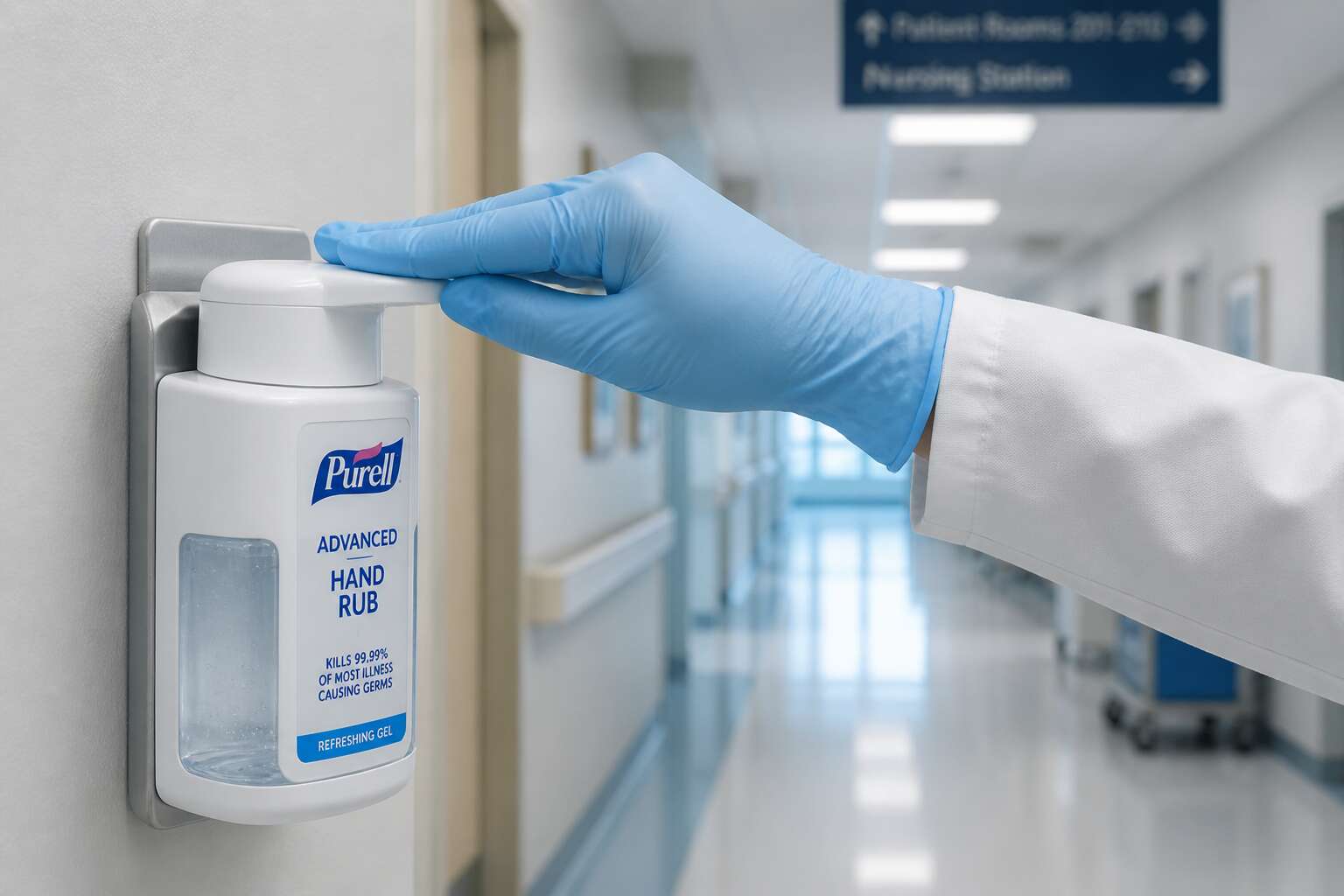
So which disinfectant is used in hospital hand hygiene programs? Alcohol-based rubs. The World Health Organization recommends 60% to 80% alcohol. Below that, killing power drops. Above, the liquid dries before it can work.
Alcohol has limitations. It is flammable, damages some plastics and rubber, and strips the skin of natural oils. It is not sporicidal, so a question like which disinfectant is used in hospital units battling C. difficile will never answer with alcohol. For everyday microbial load, though, nothing matches its speed.
Accelerated Hydrogen Peroxide (AHP)
Accelerated hydrogen peroxide, AHP, modifies a known molecule. Low concentration peroxide plus surfactants and catalysts works faster than standard hydrogen peroxide. It breaks down into oxygen, water, and a benign acid, leaving no residue. This delivers efficiency during short patient care cycles.
South African hospitals face pressure to control healthcare associated infections. AHP products provide sporicidal activity, missing from alcohol rubs. So when teams decide which disinfectant is used in hospital, AHP balances speed with safety. It acts against bacteria, enveloped viruses, and tuberculosis bacilli, while remaining compatible with brass and aluminum.
Facilities value its low volatile organic compound content, reducing occupant exposure. Disposal occurs naturally, requiring no special ventilation. With these traits, AHP is a core component of environmental hygiene in South Africa.
Application Methods and Safety Protocols
Manual Wiping vs. Spraying vs. Fogging
Manual wiping remains the gold standard in South African hospitals. Friction removes bioburden that sprays simply push around. You cannot shortcut this step, no matter which disinfectant is used in hospital protocols.
Spraying covers large surfaces quickly, but it demands precise contact time. Fogging reaches hidden corners, yet it requires empty wards and specialized equipment. Each method changes how the chemistry performs.
- Wipe for high-touch surfaces and visible soil.
- Spray for walls and broad areas.
- Fog only as an adjunct, never a replacement.
Safety protocols dictate PPE, ventilation, and dwell times. Staff must verify compatibility before application. The choice of which disinfectant is used in hospital settings matters less than the discipline behind the method.
Proper Dilution and Mixing Guidelines
Dilution errors turn potent concentrates into useless water or hazardous residue. I have seen staff trust their eyes over a measuring jug, and the results always disappoint. The label specifies the exact ratio. Measuring pumps and calibrated jugs remove the guesswork. Always add disinfectant to water, never the reverse, to control splashing and fumes.
Each product has its own mixing ritual. Some concentrates require lukewarm water to activate, while others lose effectiveness in hard water. Verify the local supply against the certificate of analysis. This determines which disinfectant is used in hospital wards.
- Wear gloves and eye protection before opening concentrates.
- Label diluted solutions with the preparation date.
- Never top up containers; clean, dry, and refill them.
Safety protocols protect everyone who breathes those vapours. Ventilation remains non-negotiable! Keep a spill kit within arm’s reach. When staff respect the chemistry, they respect dwell times and concentration limits.
Personal Protective Equipment (PPE) Requirements
Choosing the right disinfectant is only half the battle. The application method determines if the product actually works. Manual wiping with a cloth saturated in disinfectant remains the gold standard because it combines chemical action with physical removal of soil and microbes. Spraying alone can miss crevices and often leaves surfaces too wet, which extends dwell times and risks slips.
Safety is non-negotiable in a hospital environment. Staff must correctly use Personal Protective Equipment to prevent chemical exposure.
– Nitrile gloves are essential; latex can degrade with certain chemicals.
– Eye protection is mandatory when using high-level disinfectants like hydrogen peroxide.
– A fluid-resistant apron protects uniforms from splashes.
The question of which disinfectant is used in hospital settings ultimately depends on the task, but the application must always follow protocol. The best product fails if applied incorrectly. Proper ventilation and adherence to contact times ensure both patient safety and staff health.
Ventilation and Environmental Considerations
Ventilation dictates whether a disinfectant is safe to use. Without proper air exchange, the chemical lingers in the workspace, settling into the operator’s breathing zone. The question of which disinfectant is used in hospital settings is in reality a question of airflow volume. A formula proved reliable in an operating theatre with twelve changes per hour can become a hazard in a general ward with only two.
Environmental humidity shifts the outcome. In a dry Pretoria winter, a solution loses its moisture before the contact time is fulfilled. At eighty percent humidity in a coastal ward, the wet virus remains, but the residue may spread beyond the treated area. This environmental variable is as important as the active ingredient in the drum.
Spill Management and Emergency Procedures
Applying a disinfectant is a deliberate act, not a ceremonial one. The chosen agent matters, but so does the manner of its introduction to the surface. A colleague who mops a spill with the same casual indifference as a waiter clearing a table is a menace. The question of which disinfectant is used in hospital corridors becomes secondary when the applicator treats the task as an afterthought.
Spill management demands a particular temperament. Blood, vomit, or worse, the response must be methodical rather than theatrical. One secures the area, dons the necessary barriers, and works from the periphery inward. A numbered sequence helps:
- Isolate the spill and post a warning.
- Cover with absorbent material and allow contact time.
- Remove the bulk, then disinfect the affected zone thoroughly.
Emergency procedures require the same clarity. The answer to which disinfectant is used in hospital emergencies is often the one already in the room, mixed and ready. Hesitation is a luxury nobody can afford.
Regulatory Standards and Compliance in Healthcare Disinfection
EPA Registration and Label Claims
In the hushed, sterile wards of a South African hospital, the selection of a disinfectant is governed by strict regulatory oversight. The EPA registration on the product label is the primary mark of legitimacy, indicating the formulation has survived rigorous efficacy testing. Registration alone does not answer which disinfectant is used in hospital practice. That answer emerges from the label claims, where specific pathogen data is documented for scrutiny.
Environmental services teams must reconcile these claims with the facility’s risk profile. A disinfectant validated for bactericidal activity may offer little defence against resilient spores. The label prescribes the conditions for success: contact time, dilution, and surface compatibility.
Review each label for the following:
- Active ingredient concentration
- Listed target pathogens
- Approved surfaces and materials
- Required contact time
- Dilution instructions
These details determine which disinfectant is used in hospital workflows, ensuring every choice aligns with documented compliance rather than habit. The label is the contract between manufacturer and facility.
CDC Guidelines and HICPAC Recommendations
The question of which disinfectant is used in hospital settings across South Africa carries a weight that extends far beyond the cleaning trolley. It is a decision that intersects with patient safety, occupational health, and the relentless fight against healthcare-associated infections. While the market offers a vast array of products, the choice within a South African context is defined by a rigorous framework that prioritizes efficacy against the pathogens that pose the greatest local threat.
To understand this selection, one must first grasp that the term “disinfectant” is not a monolith. The active chemistry, whether it is a chlorine-releasing agent, a quaternary ammonium compound, or a hydrogen peroxide blend, dictates its spectrum of activity. The question of which disinfectant is used in hospital practice is often answered by the specific clinical scenario. A high-touch surface in a general ward demands a different profile than surgical instruments or a spill of blood products. Consequently, hospitals rely on a tiered approach, where the risk of infection determines the level of disinfection required, from low-level cleaning to high-level sterilization.
The regulatory landscape, while grounded in international standards, has distinct local applications. The South African Health Products Regulatory Authority (SAHPRA) oversees the registration of disinfectants as household or institutional products, depending on their claims. However, the practical decision-making within a hospital rests with infection prevention and control (IPC) committees. These committees scrutinize the label, not as mere marketing, but as a legal document. They ask which disinfectant is used in hospital protocols for specific organisms like Klebsiella pneumoniae or Acinetobacter baumannii, and they demand proof of efficacy against these strains, often requiring test data from accredited laboratories that reflect local resistance patterns.
This brings us to the concept of contact time, a factor that is frequently misunderstood yet is critical in determining whether a disinfection process succeeds. A product may be highly effective against Mycobacterium tuberculosis, but if the surface is wiped dry in fifteen seconds when the label mandates a five-minute dwell time, the process is a failure. The selection, therefore, is not just about the chemistry in the bottle but about the operational discipline of the staff using it. Training programs must convert the label’s instructions into habitual action, ensuring that the chosen product is applied with the correct dilution and left for the full specified period. This operational layer is often the difference between a compliant environment and one that merely appears clean.
Material compatibility also narrows the field. The question of which disinfectant is used in hospital environments cannot ignore the surfaces themselves. Modern hospital infrastructure includes a significant amount of electronic equipment, plastics, and softer furnishings. An aggressive chemical that degrades these materials over time can create micro-cracks where pathogens can harbor, paradoxically increasing the infection risk. For this reason, many South African facilities are shifting towards accelerated hydrogen peroxide (AHP) wipes for electronics and other sensitive areas. These products offer high efficacy with excellent material safety, reducing the long-term cost of asset replacement while maintaining a high standard of hygiene.
The economic reality of the South African healthcare system, which spans both a high-tech private sector and a resource-constrained public sector, influences procurement strategies. While cost per litre is a primary consideration, the true cost-effectiveness is calculated through the lens of clinical outcomes. A cheaper product that requires a longer contact time or a higher concentration may ultimately be less efficient than a more expensive product that acts faster, thereby increasing room turnover rates and reducing labour costs. Decision-makers must perform a delicate balancing act, weighing the upfront expenditure against the potential cost of a single healthcare-associated infection, which can be substantial.
Ultimately, the definitive answer to which disinfectant is used in hospital settings is not a single brand name but a standardized principle. It is the product that meets the stringent requirements of EN or ASTM standards, holds valid SAHPRA registration for the intended claims, demonstrates efficacy against the specific pathogens prevalent in that facility, and can be used correctly by the staff within the available resources. The chosen product must seamlessly integrate into the facility’s workflow, from the housekeeping staff to the surgical theatre team. It is a decision made in committee rooms, guided by evidence, and verified through environmental monitoring and clinical surveillance, ensuring that the hospital remains a place of healing, not a source of harm.
OSHA Bloodborne Pathogens Standard
While the OSHA Bloodborne Pathogens Standard is an American regulation, its influence reaches South African hospital corridors. It established the expectation that any surface contaminated with blood or bodily fluids demands an immediate, validated disinfection response. This principle informs local occupational health compliance, pushing facilities to verify exactly which disinfectant is used in hospital protocols for such exposures.
South African hospitals align their purchasing with SAHPRA’s registered claims and the Occupational Health and Safety Act’s duty of care. Infection prevention committees audit labels as legal documents rather than marketing sheets.
Compliance requires documented proof for each product:
– Efficacy against bloodborne pathogens like hepatitis B and HIV
– Valid registration for hospital-grade claims
– Staff training records on correct application and dwell times
This regulatory architecture ensures the chosen chemistry remains provably effective in practice.
Joint Commission Accreditation Requirements
The Joint Commission may not station surveyors in South Africa, but its accreditation standards appear in more local quality reports every year. International hospitals seeking that recognition quickly learn that inspection day is not about trust. Surveyors request the batch number, the dilution ratio, and the training record for the staff member holding the trigger bottle. In short, they demand proof of which disinfectant is used in hospital areas exposed to high-risk body fluids. Facilities pursuing this path adopt checklist cultures that feel excessive until an auditor asks why a label was missing. The clipboard becomes the most important instrument in the room. The process is procedural, not personal. Accreditation simply requires a facility to demonstrate its choices rather than announce them.
Emerging Trends in Eco-Friendly and Sustainable Disinfectants
Regulatory oversight in South African healthcare settings is moving beyond initial approval toward proof of ongoing compliance. The question of which disinfectant is used in hospital settings now covers procurement records, rotation schedules, and validation results. Infection prevention committees review dilution logs and storage temperatures, because inconsistent formulation weakens any brand.
Eco-friendly chemistry is shifting from a niche request to a procurement requirement. Sustainable options typically share several attributes:
- Biodegradable active ingredients that retain sporicidal claims
- Concentrated refill systems reducing packaging waste
- Lower volatile organic compound emissions
Hydrogen peroxide-based products decompose into water and oxygen, appealing to both infection control teams and sustainability officers. The real test remains whether green alternatives duplicate the performance of traditional formulas under demanding field conditions.
0 Comments